
Assessments
Constraint Structure
Polargrade identifies six structural constraints that govern why complex operations fail in remote and extreme environments.
Each assessment examines one constraint independently.
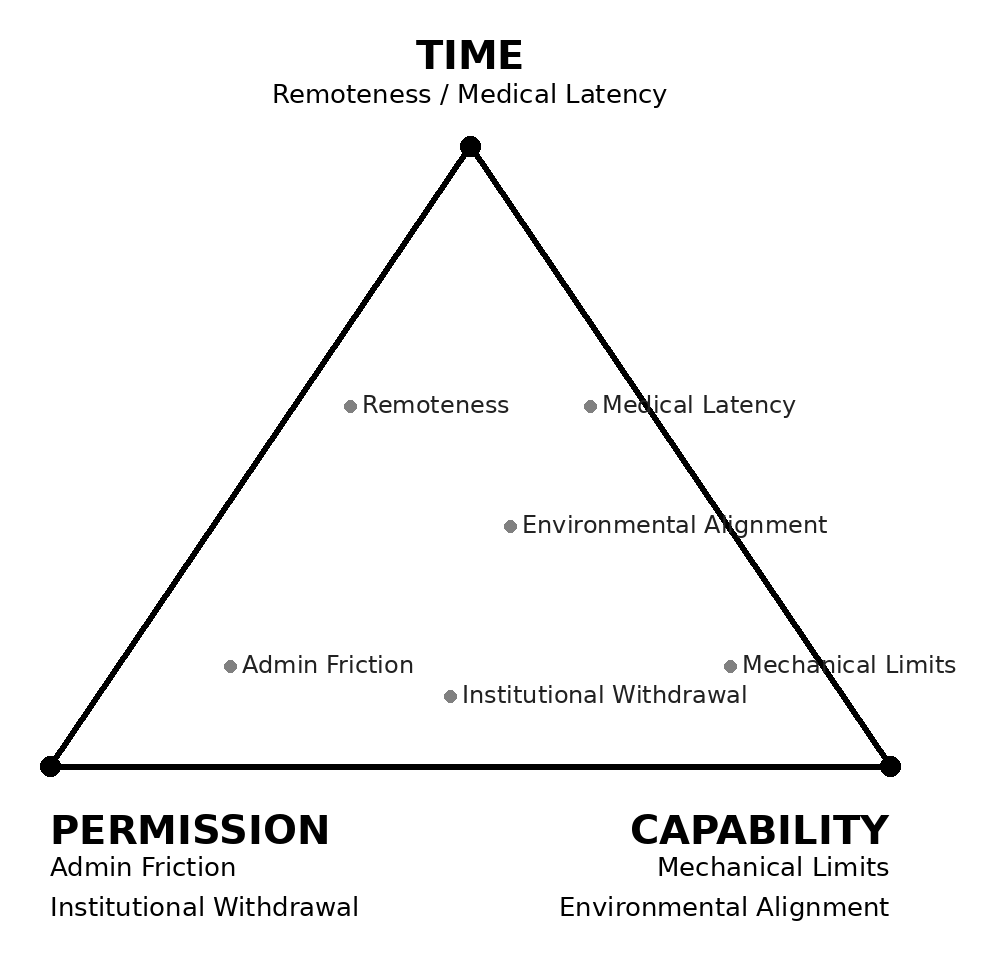
Polargrade Constraint Axes
The six Polargrade constraints operate across three structural axes that determine the feasibility of complex operations: time for intervention, physical capability, and institutional permission.
Operational Meaning of Remoteness and Its Decision Consequences
Foundational assessment defining remoteness as delayed intervention and its decision consequences.
Medical Events and Evacuation Latency
Decision-dominant assessment examining medical emergencies and evacuation latency in polar environments.
Jurisdictional and Administrative Friction
An institutional analysis of why rescue, evacuation, and corrective intervention are delayed by authority and liability—not distance or capability—in remote environments.
Mechanical Failure and Redundancy Limits
Explains why mechanical redundancy frequently collapses under remoteness due to shared failure modes, hidden dependencies, and constrained maintenance, converting distributed systems into single-point failures.
Environmental Constraint Alignment
Explains how environmental variability, seasonal availability, and cumulative system stress align to collapse feasibility, even when individual constraints remain nominal.
View assessment
Institutional Withdrawal
Explains how complex operations can become infeasible when insurance, certification, or regulatory support disappears, even though the underlying systems remain physically capable.
Together these constraints describe the structural conditions under which complex operations become infeasible.