
Polargrade Framework
Polargrade is a constraint-based analytical framework examining decision risk in environments where intervention is delayed, recoverability is limited, and early decisions dominate outcomes.
Polargrade treats complex operational environments as systems governed by structural constraints on intervention feasibility.
The framework therefore examines how constraint alignment determines when escalation remains recoverable and when it becomes structurally irreversible.
Rather than modelling hazards or estimating probabilities, Polargrade identifies structural constraints that govern whether intervention remains feasible once events begin to unfold.
These constraints operate across remote operational environments where time, authority, and capability cannot be rapidly expanded after escalation.
Polargrade assessments describe these constraints and examine how their interaction shapes the boundaries of feasible action.
Decision Environments Examined
Polargrade examines environments characterised by delayed intervention and constrained recoverability.
Typical conditions include:
- Remote or isolated operational locations
- Limited evacuation or rescue capability
- Multi-jurisdictional response authority
- Environmental volatility affecting access
- Institutional coordination requirements
In these environments, escalation cannot be assumed to trigger immediate corrective action.
Decisions must therefore account for structural limits that exist before incidents occur.
Constraint-Based Analysis
Traditional risk models frequently assume that capability can be mobilised once a problem emerges.
Polargrade instead examines environments where intervention capacity is structurally bounded.
Under these conditions:
- Capability cannot be rapidly expanded
- Authority must be established before action occurs
- Environmental access may degrade during escalation
Risk therefore emerges not primarily from hazard severity but from the alignment of constraints governing response feasibility.
Polargrade assessments define these constraints and analyse their interaction.
The Three Axes of Constraint
Polargrade analyses operate across three structural axes:
Time
Time governs the delay between escalation and the arrival of effective intervention.
Permission
Permission governs the institutional or procedural conditions that determine whether intervention is authorised.
Capability
Capability governs the physical or technical capacity required to perform intervention once authorised.
Failures frequently emerge when constraints across these axes align simultaneously, reducing or eliminating feasible response pathways.
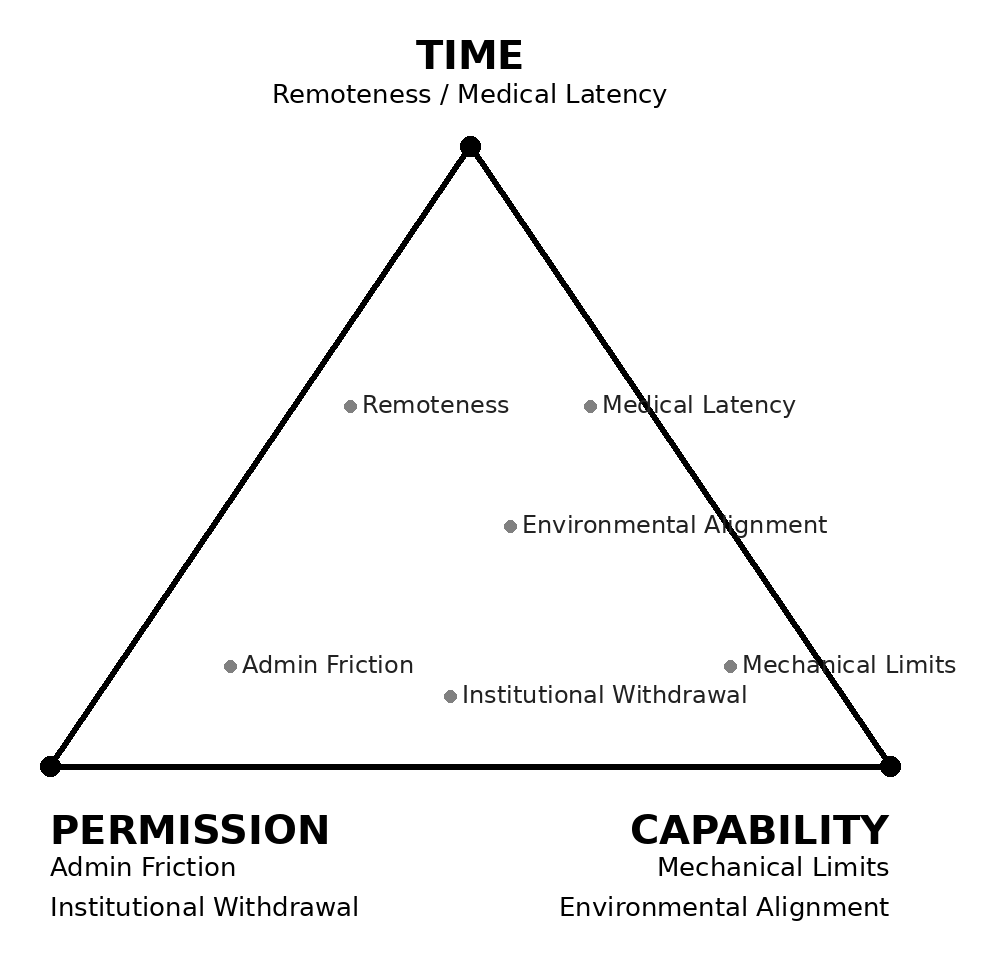
Figure: Polargrade constraint axes.
The Six Constraints
Polargrade currently defines six structural constraints that commonly govern decision environments characterised by delayed intervention:
Operational Meaning of Remoteness
Assesses how delayed access to intervention determines exposure to irreversible loss.
Medical Events and Evacuation Latency
Examines how physiological deterioration creates time-critical limits on evacuation and treatment.
Jurisdictional and Administrative Friction
Evaluates how authority requirements delay the initiation of rescue or corrective intervention.
Mechanical Failure and Redundancy Limits
Examines how redundancy systems fail when repair capability is inaccessible.
Environmental Constraint Alignment
Explains how environmental variability compresses operational windows and amplifies system stress.
Institutional Withdrawal
Examines how the removal of institutional support eliminates operational feasibility before physical failure occurs.
Each constraint describes a mechanism through which intervention feasibility can collapse.
Constraint Interaction
Individual constraints rarely determine outcomes in isolation.
Operational environments typically remain manageable while constraints remain independent or weakly coupled.
Risk escalates when constraints align across multiple axes.
Examples include:
- Environmental conditions eliminating evacuation windows during medical emergencies
- Jurisdictional uncertainty delaying rescue mobilisation despite available assets
- Mechanical failure occurring when repair capability is inaccessible
Polargrade analyses focus on identifying these alignment conditions and the points at which intervention feasibility collapses.
Application of the Framework
Polargrade applied analyses examine real or hypothetical decision environments through the lens of the constraint framework.
Each analysis:
- Defines the operational environment
- Identifies relevant constraints
- Examines interaction across the three axes
- Evaluates how alignment affects intervention feasibility
The purpose of these analyses is not to recommend action or optimise outcomes.
They instead clarify the structural boundaries within which decisions must operate.
Analytical Boundaries
Polargrade provides analytical assessments and reference material for informational and internal evaluative use.
The framework does not provide operational guidance, certification, or professional advice.
Polargrade assessments analyse structural decision environments and constraint dynamics. They do not predict specific outcomes or substitute for professional judgement, regulatory compliance, or site-specific risk assessment.
Polargrade does not participate in operational decision-making and assumes no responsibility for actions taken on the basis of its publications.