
Methodology
Polargrade provides structured analysis of decision environments where escalation is slow, reversibility is limited, and early operational decisions dominate outcomes.
These environments are typically characterised by delayed intervention capacity, constraint-binding conditions, and asymmetric loss structures. In such settings, outcomes are often determined not by the intentions of decision-makers but by the structural limits within which they operate.
Polargrade therefore evaluates decision environments primarily through the identification and interaction of operational constraints.
Rather than predicting specific outcomes, the framework assesses the structural conditions that determine whether intervention, recovery, or loss mitigation remains feasible once escalation begins.
Polargrade assessments apply this methodology to specific operational environments and institutional systems. Published analyses can be found in the Polargrade assessment index.
Analytical Premise
Polargrade is based on a simple analytical premise: complex operational environments are governed by structural constraints that limit what actions remain possible once events unfold.
These constraints operate across multiple dimensions, including time, institutional permission, and physical capability.
In environments where intervention capacity is delayed or constrained, early decisions frequently determine whether losses remain recoverable.
The framework therefore focuses on identifying the conditions under which:
- Intervention becomes delayed or impossible
- Institutional permission constrains response
- Physical or environmental limits prevent recovery
This constraint-based approach allows decision environments to be evaluated independently of individual actors, intentions, or policies.
The Polargrade Constraint System
The Polargrade framework evaluates six structural constraints that influence operational feasibility.
These constraints operate across three primary axes that determine whether intervention or recovery remains possible once escalation begins.
Time-related constraints determine how long an environment can sustain operations before intervention capacity becomes critical.
Institutional constraints determine whether response mechanisms remain authorised or operationally viable.
Physical constraints determine whether intervention remains technically possible under prevailing conditions.
The six constraints evaluated by the framework are:
- Operational Meaning of Remoteness
- Medical Events and Evacuation Latency
- Jurisdictional and Administrative Friction
- Mechanical Failure and Redundancy Limits
- Environmental Constraint Alignment
- Institutional Withdrawal
Each assessment examines how these constraints interact within a specific operational or institutional environment.
Constraint Axes
The six Polargrade constraints operate across three structural axes that determine the feasibility of complex operations.
Time represents the delay between escalation and the arrival of effective intervention.
Permission represents the institutional or procedural conditions that determine whether intervention is authorised.
Capability represents the physical and environmental limits that determine whether intervention is technically possible.
Together these axes define the structural boundaries within which operational decisions occur.
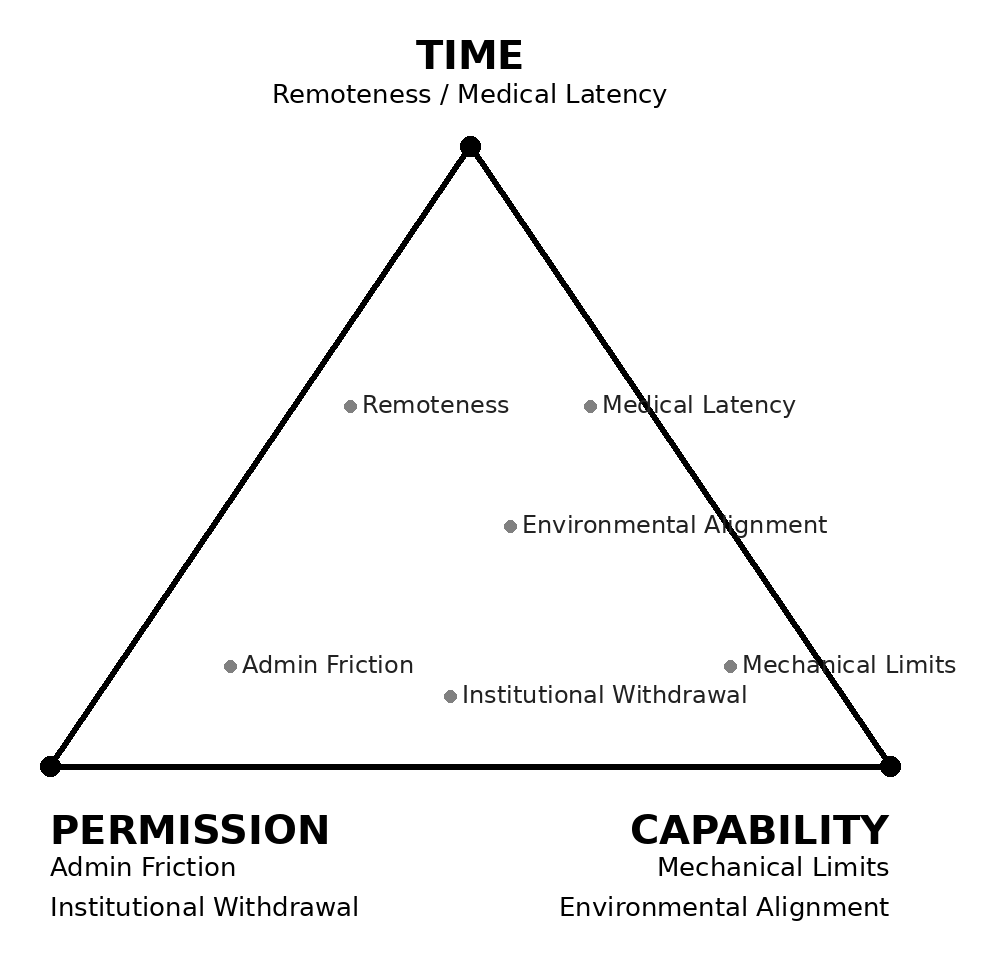
Polargrade Constraint Model
The six Polargrade constraints operate across the Time, Permission, and Capability axes that determine whether intervention, recovery, or escalation remains feasible within a decision environment.
Constraint Interaction
Operational failures rarely occur as the result of a single constraint.
Instead, loss exposure typically emerges when multiple constraints align across different axes.
Examples include:
- Remoteness combined with medical latency delaying effective intervention
- Administrative friction combined with institutional withdrawal limiting response authority
- Mechanical limits combined with environmental misalignment preventing operational recovery
Polargrade assessments therefore evaluate not only individual constraints but the conditions under which constraint combinations produce irreversible outcomes.
The framework focuses particularly on the point at which multiple constraints align to eliminate feasible recovery pathways.
The framework focuses particularly on the point at which multiple constraints align to eliminate feasible recovery pathways.
In many complex operational environments this transition represents a structural point of no return, where intervention capacity has effectively disappeared.
Polargrade examines these environments through constraint-based risk analysis, evaluating how structural limits on intervention feasibility determine operational outcomes.
Relationship To Existing Risk Models
Several analytical models are commonly used to explain how operational failures occur.
The Swiss Cheese Model describes accidents as the alignment of weaknesses across multiple defensive layers.
The Bowtie Model maps the relationship between hazards, preventive barriers, and consequence mitigation.
These models focus primarily on how failures propagate through complex systems.
Polargrade examines a different structural problem.
Instead of modelling failure pathways, Polargrade evaluates the feasibility of intervention once escalation has begun.
The framework therefore focuses on structural constraints affecting response capacity, including:
- Intervention delay
- Institutional authorisation
- Technical capability limits
Where the Swiss Cheese Model and Bowtie Model describe how failures emerge, Polargrade examines when recovery becomes structurally impossible.
In this sense, Polargrade operates upstream of consequence analysis.
The framework identifies environments in which constraint alignment removes the practical ability to intervene, regardless of the original hazard.
This distinction allows Polargrade to evaluate environments ranging from expedition logistics to aviation systems and geopolitical chokepoints using the same structural lens.
Assessment Protocol
Polargrade assessments follow a structured analytical sequence:
Environment Definition
Identification of the operational or institutional environment under evaluation.
Constraint Identification
Mapping of the six Polargrade constraints within the environment.
Axis Evaluation
Analysis of how constraints interact across the Time, Permission, and Capability axes.
Interaction Analysis
Evaluation of how constraint combinations influence intervention feasibility.
Loss Exposure Assessment
Identification of conditions under which escalation produces unrecoverable loss.
Classification
Assignment of a Polargrade assessment reflecting the structural risk characteristics of the environment.
This protocol allows different environments to be evaluated consistently under a common analytical framework.
Published assessments applying this methodology can be found in the Polargrade assessment index.
Decision Environments
The Polargrade framework is designed for environments where escalation dynamics differ from conventional operational settings.
Typical characteristics include:
- delayed intervention capacity
- limited reversibility once escalation begins
- dependence on institutional coordination
- asymmetric loss structures
Examples may include remote operational environments, constrained medical systems, institutional governance structures, or regulatory environments under stress.
Polargrade is not intended for environments where intervention capacity is immediate and reversibility remains high.
Analytical Boundaries
Polargrade provides analytical assessments and reference material for informational and internal evaluative use.
The framework does not provide operational guidance, certification, or professional advice.
Polargrade assessments analyse structural decision environments and constraint dynamics. They do not predict specific outcomes or substitute for professional judgement, regulatory compliance, or site-specific risk assessment.
Polargrade does not participate in operational decision-making and assumes no responsibility for actions taken on the basis of its publications.